Walking on Water

In my mind’s eye, I find myself sitting in a boat rocking on the sea. I sit with my knees drawn up to my chin, and my back against the side of the boat. My arms are folded across my knees. I raise my head and look around. It is very early in the morning and there is a mist in the air. Things are foggy. There is a person on either side of me, also sitting like me with their backs against the side of the boat. If fact, as a look around, the boat is fairly crowded. There are lots of people on this boat.

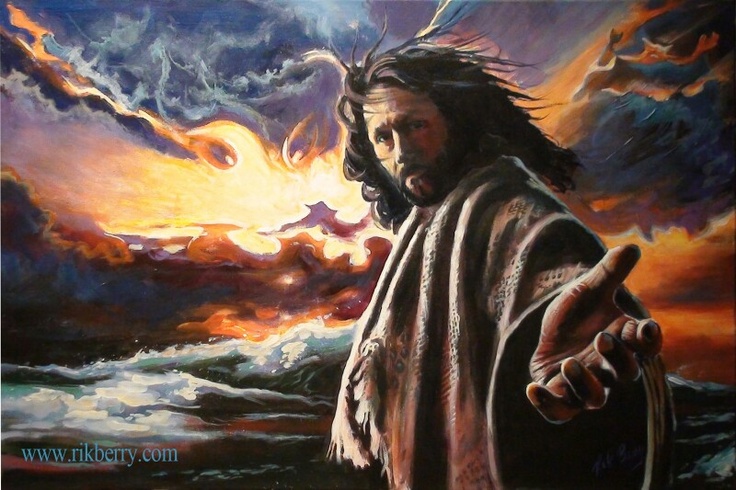
Suddenly, there is a commotion. People are up and shouting and pointing out to sea. What is it? I spring up and cross to the other side of the boat. The boat is tilting with all of the people on one side. Then I see what all of the fuss is about. I can’t believe my eyes, and I rub them with my fists. Am I really seeing, what I think I’m seeing? Its Jesus, and he is walking on the water towards the boat!

He calls to Peter to come join him on the water. Peter is shaking his head.“No,” he seems to say. But eventually, Peter climbs over the side of the boat and starts to walk on the water towards Jesus. But something happens, and Peter is now flailing and floundering in the water. Everyone is shouting! The other people help Peter back into the boat.

Jesus looks straight at me and says, “Come.” Suddenly, my heart is racing fast and my mouth is dry and sticky. My heart is pounding in my ears, muffling my hearing, but I sense that all the commotion has quieted as everyone is staring at me.The mist seems to surround us and I cannot see the shore, nor the sun. Everything is gray and shrouded. I feel disoriented.“Okay,” I tell myself, “I can do this.”

I start to climb over the side of the boat, straddling it, with one foot firmly on the deck, and one foot dangling above the water. Doubt creeps in as I wonder if I can actually do this. I look at Jesus and he looks at me, with his arm outstretched and his fingers curling towards himself. His fingers wiggle in a ‘come here’ motion. “Well’, I think, “if Jesus says I can walk to him, who am I to argue?” I carefully ease myself down the side of the boat, tenderly tapping my toe on the water. It’s firmer than I expected. I take a step or two. “I’m walking!”, I think. I look up at Jesus and he nods his head. Tentatively I walk, slowly gaining confidence. Eventually, I stride across the water towards Jesus. When I get to him, he takes my hand in his and tells me, “Salvation is not of the body, it is of the mind, and it is of the spirit.” I think to myself, what a strange thing to say.

Lola’s Reflection
This vision is all about faith, doubt, and trusting. There is lots of water in various forms: the sea, the mist, the fog, the clouds. Water, which is often a metaphor for spirit, is the foundation upon which the boat rocks and Jesus walks. Yet, fog and mist represent an inability to see clearly, and it appears that I am being asked to have faith even when things are obscure or uncertain. I wonder, what does it take to have faith when another before you seems to have lost their faith? Is it possible to have confidence amongst uncertainty? Can I trust someone who asks me to do the impossible?

As I released my own doubt, and had a little willingness combined with trusting Jesus, I was able to walk on the water, and eventually, with confidence. The ending is strange, however, and I am left ponder the meaning of salvation. The message seems to be, that the body is not in need of salvation, but my mind and spirit are.
“Look here.”

An experience of hearing a guiding voice, shared by Viv Hawkins

I was finding my job extremely difficult. I loved the mission of the organization with which I worked. The workplace setting, commute, and benefits were all pretty good. Given those factors, the compensation was acceptable. I valued almost every one of my colleagues.

And then there was my supervisor – a new director with a penchant for micromanaging and a tendency to undervalue his direct reports. He had hired a fantastic staff for our start-up office. But, one-by-one, we were walking away from work to which we were devoted because it felt our wings were continually being clipped.

I carried my distress to Quaker worship one Sunday and, during the mostly-silent waiting worship practiced by unprogrammed Friends, wrestled with what to do career-wise. I was at a loss, having tried repeatedly to talk with my supervisor and feeling no change. Do you know that sense when everything you know to do leaves you unresolved?

Sometimes for me that state of extreme frustration carries me through a desperate search, into a place of lamentation, and leads to an ultimate surrender. A giving over more than a giving up. A willingness to release whatever I think I know to something greater. A feeling reminiscent of Jesus’ words, “Into your hands I commit my spirit,” his last words on the cross.

That was the journey I underwent that Sunday during worship.

And the words that I heard in response were few but clear, as if whispered into my ear, “Look here.”

Despite the fact of hearing such a voice being a new, unexplainable experience for me, I felt the calm that comes with a release of pent-up emotion and received the guidance as some form of divine instruction.

Leaving the worship space soon afterward, when those present moved to the social room for refreshments, I found myself standing at a table of printed announcements. The top sheet was a job description for a position for which I subsequently applied, was hired, and in which I served for the next five years.

Twenty-five years later, I do not know the source of that voice. But, if we define “mystical experience” as Lola does as “an intangible aspect of life,” this was surely one.


Post-script:
Were I still as connected to scripture and/ or less doubting than the Apostle Thomas, I might close with a later portion of that psalm begun by Jesus: “Yet you heard my cry for mercy/ when I called to you for help.” Perhaps, that closing works for you?

Among Old-growth

An experience of the vast harmony of nature during self-led forest bathing, shared by Viv Hawkins.

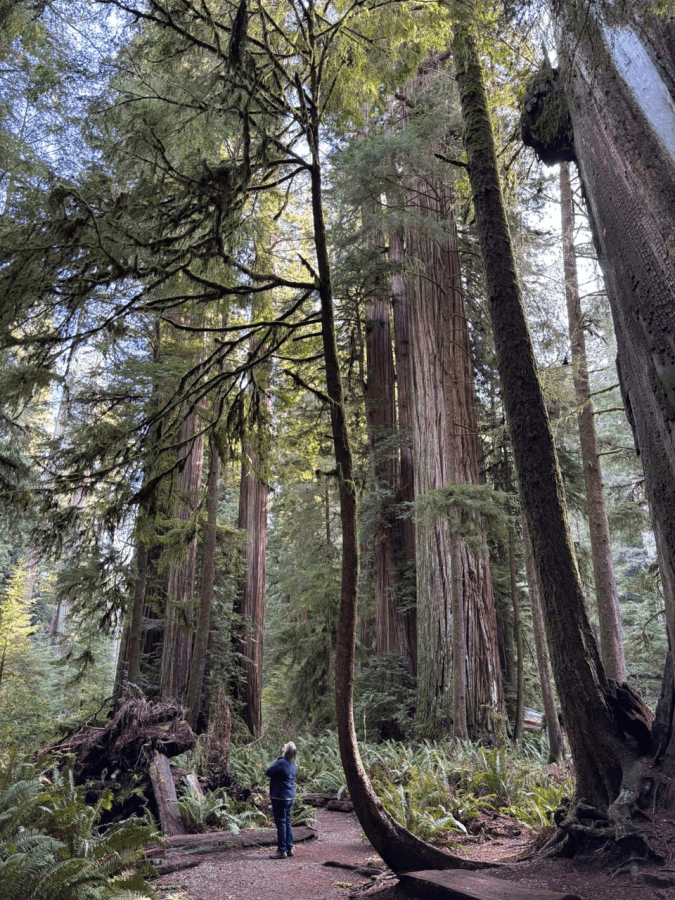
There among the old-growth redwoods of northern California. Massive. Towering. The tallest trees on this awe-inspiring planet.

We had been on this trail before today. And I had been on it for some time that day.

And then, out of the blue, it hit me.

An immense gratitude for these beings. Helping to balance the simultaneously resilient and fragile ecosystems on which we and all life on earth depend. Breathing in what we breath out. Standing here for centuries, growing both taller and wider in circumference. So tall they need to drink from both their roots and their foliage that catches clouds.

Scarred by fire how many times?! Fire sometimes caused by human activity, whether that be setting the fire inadvertently or not offering the controlled burn care practiced by Indigenous people before colonizers tried to suppress all natural fire.

Alive even in their death after their shallow roots, intertwined with others of their species surrounding them, give way and the giant topples BOOMING. How does that koan go? If a tree falls in a forest and there is no one there to hear, does it make a sound? I have no doubt they do.

My feet feel the shudder still vibrating in the ground beneath the silent softness of redwood needles and cones as small as grapes, each containing countless seeds of giants.

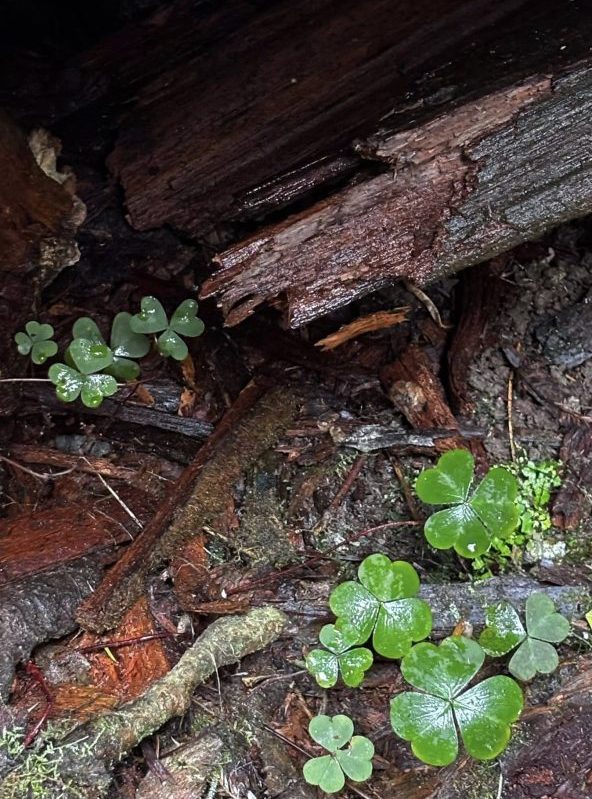
Even fallen, they give, as their bodies are offered up to sword fern spores and sorrel seeds, that explode from fruit which forms from the sorrel flower, only the leaves of which I’ve seen.

I stood there with tears streaming down my face, my heart as full as I’ve known it, and a gratitude that I sensed was MASSIVE but, at the same time, could never somehow match the scope of these trees in size, abundance, longevity, or criticality to the ecosystem of which they, no we, are together a part.

In that HUGE love I experienced the wonder of the universe; the incomprehensible, mysterious, complexity of life; the grace that surrounds us every single moment; and a sense of connectedness to All-in-All.

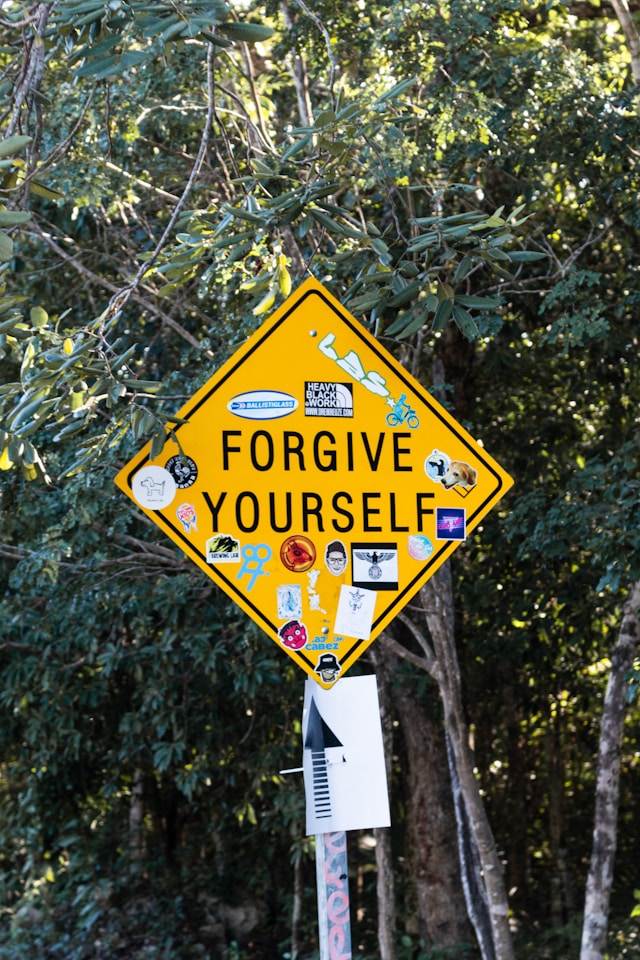
Forgiveness

My therapist once said to me, that forgiveness is like putting someone in a cage. Once put in the cage, they must be watched by a guard to ensure that they do not escape. I can stand guard as long as I want, but if I truly want to be free – to be liberated, I have to relinquish the role of guard, for it also keeps me chained to the cage. Forgiveness, therefore, becomes my release from the past, in order to liberate the future.

Forgiveness can be a difficult practice, extremely difficult. For decades, I have had a practice of attempting to forgive the harms of the day as I drift off to sleep. Starting with the harms of the day, enabled me to slowly forgive the bigger traumas in my life. Over time, I’ve become better at forgiving myself, other people, and my sense of injustice that the world is not as I believe it should be.

In the news of late, there has been talk of preemptive strikes, where one nation believes it is justified in attacking another nation. The idea is to use violence as a deterrent to violence. In this context I was thinking about the opposite of a preemptive strike, and words from beyond entered my consciousness with the phrase, ‘preemptive forgiveness.’

I began to explore the idea of ‘preemptive forgiveness‘, and have been practicing it for the last few years in two contexts, with groups, and with individual people.

Suppose I have a meeting that I dread, or an event I feel obligated to attend. Perhaps I have a sports team I root for, legislation I like to see passed, or an upcoming holiday gathering. I have practiced forgiveness long enough to know that, no matter what happens with this group, tonight I will be offering forgiveness as I drift off to sleep. With the practice of preemptive forgiveness in mind, I can forgive before anything happens. This has changed my experience of one from leaving angry or irritated, to entering with curiosity. What will happen here that I have already forgiven? What irritant will surface? How many irritations will there be? I must say that I have found delight in playing this game of discovery. There it is! The first thing from this meeting that I have already forgiven! How many more will there be?

In a similar way, I practice preemptive forgiveness with people. What might she say during this phone call, that I will forgive later tonight? How might he treat me, that while rude, is also completely forgivable? How can they be so self absorbed, that they do not notice how their actions affected me? I could just as easily forgive before I engage, and shorten my end-of-day forgiveness list, which has been a pleasant side effect. In a similar way, preemptive forgiveness in relation to my partner has been a healing practice. A prayer of preemptive forgiveness in the morning as I rise – knowing full well that no matter what transpires today, I will forgive her tonight – allows me to have a sense of humor about life. “Oh! There it is! She said the thing, she did the thing, that I have already forgiven her for.” She knows that I engage with preemptive forgiveness, so these moments have gone from irritations and relational strain, to moments of humor and warm affection.

Of course, forgiveness and preemptive forgiveness are practices, more easily said than done. Forgiveness can be hard. Preemptive forgiveness can be a fun game. However, I am no longer interested in guarding cages. But the practice of forgiving, over and over again, will be with me for all of the days to come.

“Father forgive them, for they know not what they do.” – Jesus, Luke 23:34

Forest Bathing

Forest bathing is the practice of immersing ourselves in natural settings, particularly but not exclusively, forests. It involves slowing down and paying attention to our natural surroundings with our full complement of bodily senses: smell, sight, hearing, touch, and taste. Here’s how:

1. Find a location in nature 

The ideal place is a quiet area surrounded by trees. Environments with greater tree cover and natural sounds may be especially effective at reducing human stress and mental fatigue. But any natural space, including urban parks, is suitable. 

2. Set aside time 

Forest bathing and spending more time in nature has been shown to contribute great benefits. Although two to six hours is considered ideal, as little as 15 minutes in a natural setting can help reduce stress and anxiety.

3. Aim to reduce your heart rate

Forest bathing is most effective when you move at a slow and gentle pace. Slower movement contributes to lower heart rate and blood pressure, and helps the nervous system settle. Instead of approaching this time as exercise, move slowly to invite your body to shift out of fight/flight mode into rest and recovery. 

4. Engage all your senses

Using all five of your physical senses helps deepen the restorative effects of forest bathing. You might ask yourself: What scents do I smell? What sounds can I hear? What textures do I feel beneath my feet or fingertips? In addition to what we see, paying attention to sounds, textures, and smells helps root the body and mind more fully in the present moment.

5. Take a moment to meditate

Pausing can help augment and complete the forest bathing experience. Find a quiet place to sit and practice simple meditation, such as gentle breathing exercises, journaling, self-affirmations, or quiet observation to allow your mind to slow and settle. Even a few minutes of stillness in nature can ease tension and deepen a sense of calm.

This form of “nature therapy” offers a wide range of benefits for our physical, emotional, and spiritual selves, including decreasing undue stress and potential burnout and boosting your immune system.

Attention

Give Unto Ceaser

In my mind’s eye, I am sitting on stone. It is hot, the sun is bright, and I am squinting with the brightness of it. I realize that the stone I am sitting upon is part of a temple. Jesus is there and he has a stick in his hand. He is aimlessly drawing figures in the sand with the stick. He is surround by many people, and I can tell that some are friends and some are foes, but I am confused as to which are which. People are asking him questions and he is answering them in a bored sort of way. 

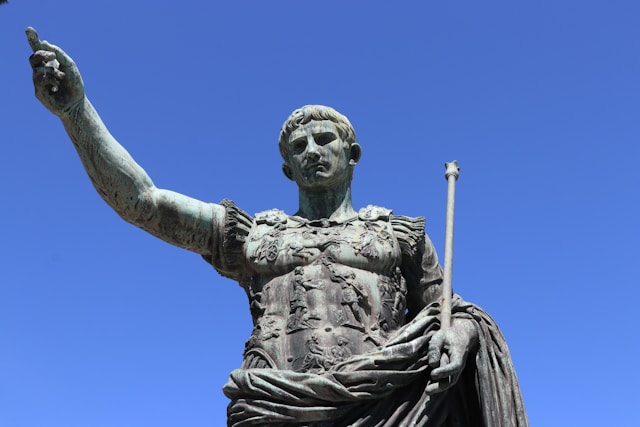
One man, dressed in fine silk robes that are beyond what I could ever afford, is flattering Jesus, who looks at him with a cocked eyebrow. “Master,” the man says, “we know you are very wise. Tell us, should we pay taxes to Caesar?” The crowd around Jesus starts to murmur, and the tension in the air rises. It feels like a trap, and I can feel the anxiety of the others around me electrify the hot, desert air. 

“Give me a coin,” Jesus says, and the man obliges him. “Whose face is on this coin?”, Jesus asks. Someone from the crowd yells, “Why Caesar’s, of course!” Jesus flips the coin into the crowd and says, “Give to Caesar what belongs to Caesar, and give to God what belongs to God.” The crowd starts to murmur more loudly, “What does he mean?”, they ask.

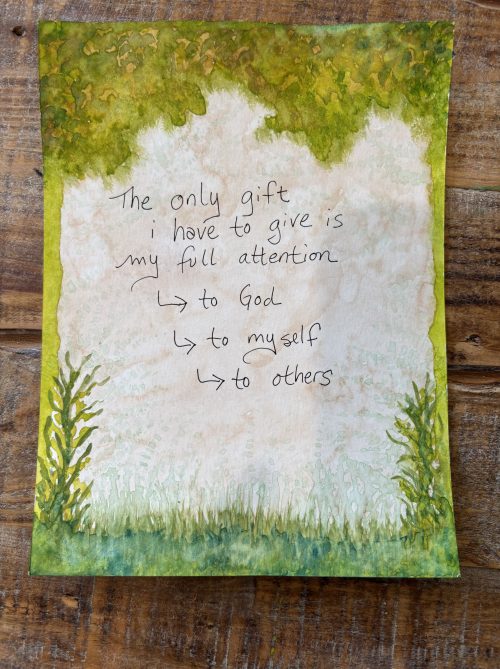
All of this is commotion is irrelevant to me. I move closer to Jesus, inching my way through the crowd. I get to his side, and he looks me in the eye. “What do I have to give to God?”, I ask him, trying not to return his gaze by looking down at his sand drawings. His interest is peaked. He places his hand on my chin, raises my eyes to his, and says, “the only thing you have to give to God.” My mouth is dry and I feel stupid. “What is that?” I ask. “My child,” he answers, “the only thing you have to give to God is attention. Spend time with God, in prayer, in listening, in communion. That is the only gift God asks for, and the only gift you have to offer. Your heart belongs with God.” Jesus reaches his hand skyward and my gaze follows his fingertips upwards.Then my gaze follows as Jesus guides his hand, and places it on his heart, continuing, “As we belong with God.”

I look away from him. The intensity of his gaze is too much. His attention on me is too much. And I wonder, when God has given me so much, why do I squander opportunities to give back to God?

Lola’s Reflection:
I notice in this vision a sense of dryness, heat, and perhaps a spiritual thirst in the crowd, and in myself. There are two conflicts here. The first in the form of a trickster, represented by a spiritual seeker who tries to trick Jesus into giving a wrong answer. However, Jesus turns the question back on the trickster by turning away from material concerns and towards spiritual concerns. The second conflict is an internal conflict within myself. Unlike the trickster who sought a direct answer to his question and did not get it, I received a direct answer to my question and did not necessarily like it. The question of what belongs to God, seems to be on my mind alone. Also, I am reluctant to ‘look Jesus in the eye’, which is a metaphor for telling the truth to someone, the implication of which is that if I am looking away, I am not being honest. In the end, the question I am left with is ‘am I willing to be honest with myself about where my attention lies, or about where my heart belongs?’.

Black Modern Mystic

This project is rooted in the belief that knowledge should be both rigorous and livable. Drawing from theology, cultural criticism, Black studies, and spiritual practice, Black Modern Mystic translates academic inquiry into accessible essays, audio-visual conversations, and reflections grounded in radical truth-telling.

Black Modern Mystic is also relational. The work grows out of real conversations with thinkers, artists, organizers, and creatives—people I love learning with and who are modern mystics in their own right.


Journaling

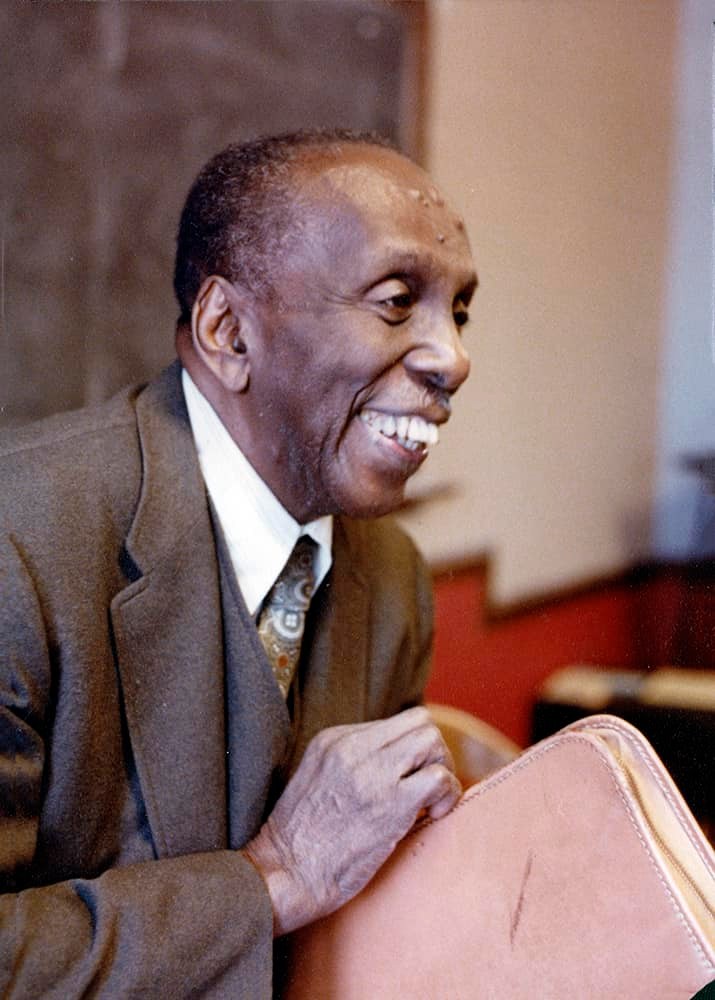
Howard Thurman

“How good it is to center down! To sit quietly and see one’s self pass by! The streets of our minds seethe with endless traffic; our spirits resound with clashing, with noisy silences, while something deep within hungers and thirsts for the still moment and the resting lull.” – Howard Thurman