Forest Bathing

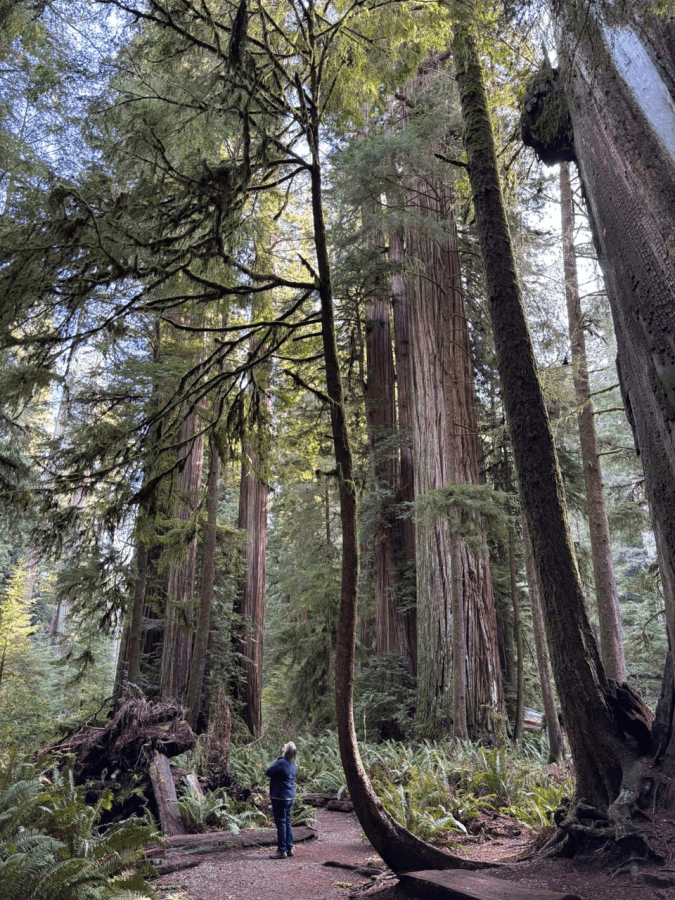
Forest bathing is the practice of immersing ourselves in natural settings, particularly but not exclusively, forests. It involves slowing down and paying attention to our natural surroundings with our full complement of bodily senses: smell, sight, hearing, touch, and taste. Here’s how:

1. Find a location in nature 

The ideal place is a quiet area surrounded by trees. Environments with greater tree cover and natural sounds may be especially effective at reducing human stress and mental fatigue. But any natural space, including urban parks, is suitable. 

2. Set aside time 

Forest bathing and spending more time in nature has been shown to contribute great benefits. Although two to six hours is considered ideal, as little as 15 minutes in a natural setting can help reduce stress and anxiety.

3. Aim to reduce your heart rate

Forest bathing is most effective when you move at a slow and gentle pace. Slower movement contributes to lower heart rate and blood pressure, and helps the nervous system settle. Instead of approaching this time as exercise, move slowly to invite your body to shift out of fight/flight mode into rest and recovery. 

4. Engage all your senses

Using all five of your physical senses helps deepen the restorative effects of forest bathing. You might ask yourself: What scents do I smell? What sounds can I hear? What textures do I feel beneath my feet or fingertips? In addition to what we see, paying attention to sounds, textures, and smells helps root the body and mind more fully in the present moment.

5. Take a moment to meditate

Pausing can help augment and complete the forest bathing experience. Find a quiet place to sit and practice simple meditation, such as gentle breathing exercises, journaling, self-affirmations, or quiet observation to allow your mind to slow and settle. Even a few minutes of stillness in nature can ease tension and deepen a sense of calm.

This form of “nature therapy” offers a wide range of benefits for our physical, emotional, and spiritual selves, including decreasing undue stress and potential burnout and boosting your immune system.

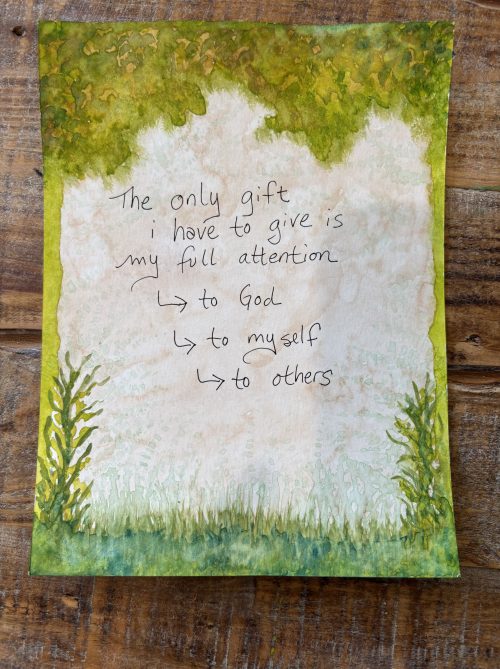
Attention

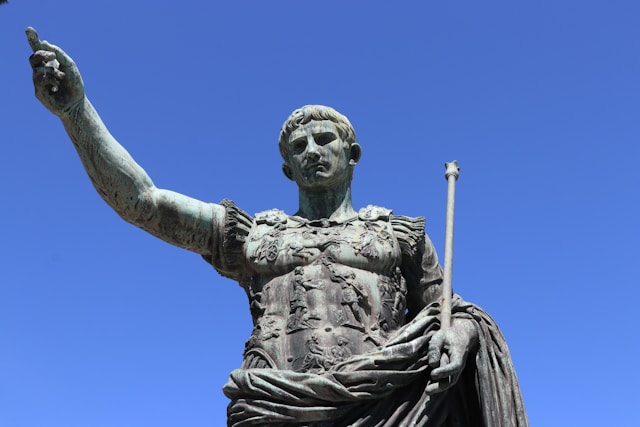
Give Unto Ceaser

In my mind’s eye, I am sitting on stone. It is hot, the sun is bright, and I am squinting with the brightness of it. I realize that the stone I am sitting upon is part of a temple. Jesus is there and he has a stick in his hand. He is aimlessly drawing figures in the sand with the stick. He is surround by many people, and I can tell that some are friends and some are foes, but I am confused as to which are which. People are asking him questions and he is answering them in a bored sort of way. 

One man, dressed in fine silk robes that are beyond what I could ever afford, is flattering Jesus, who looks at him with a cocked eyebrow. “Master,” the man says, “we know you are very wise. Tell us, should we pay taxes to Caesar?” The crowd around Jesus starts to murmur, and the tension in the air rises. It feels like a trap, and I can feel the anxiety of the others around me electrify the hot, desert air. 

“Give me a coin,” Jesus says, and the man obliges him. “Whose face is on this coin?”, Jesus asks. Someone from the crowd yells, “Why Caesar’s, of course!” Jesus flips the coin into the crowd and says, “Give to Caesar what belongs to Caesar, and give to God what belongs to God.” The crowd starts to murmur more loudly, “What does he mean?”, they ask.

All of this is commotion is irrelevant to me. I move closer to Jesus, inching my way through the crowd. I get to his side, and he looks me in the eye. “What do I have to give to God?”, I ask him, trying not to return his gaze by looking down at his sand drawings. His interest is peaked. He places his hand on my chin, raises my eyes to his, and says, “the only thing you have to give to God.” My mouth is dry and I feel stupid. “What is that?” I ask. “My child,” he answers, “the only thing you have to give to God is attention. Spend time with God, in prayer, in listening, in communion. That is the only gift God asks for, and the only gift you have to offer. Your heart belongs with God.” Jesus reaches his hand skyward and my gaze follows his fingertips upwards.Then my gaze follows as Jesus guides his hand, and places it on his heart, continuing, “As we belong with God.”

I look away from him. The intensity of his gaze is too much. His attention on me is too much. And I wonder, when God has given me so much, why do I squander opportunities to give back to God?

Lola’s Reflection:
I notice in this vision a sense of dryness, heat, and perhaps a spiritual thirst in the crowd, and in myself. There are two conflicts here. The first in the form of a trickster, represented by a spiritual seeker who tries to trick Jesus into giving a wrong answer. However, Jesus turns the question back on the trickster by turning away from material concerns and towards spiritual concerns. The second conflict is an internal conflict within myself. Unlike the trickster who sought a direct answer to his question and did not get it, I received a direct answer to my question and did not necessarily like it. The question of what belongs to God, seems to be on my mind alone. Also, I am reluctant to ‘look Jesus in the eye’, which is a metaphor for telling the truth to someone, the implication of which is that if I am looking away, I am not being honest. In the end, the question I am left with is ‘am I willing to be honest with myself about where my attention lies, or about where my heart belongs?’.

Black Modern Mystic

This project is rooted in the belief that knowledge should be both rigorous and livable. Drawing from theology, cultural criticism, Black studies, and spiritual practice, Black Modern Mystic translates academic inquiry into accessible essays, audio-visual conversations, and reflections grounded in radical truth-telling.

Black Modern Mystic is also relational. The work grows out of real conversations with thinkers, artists, organizers, and creatives—people I love learning with and who are modern mystics in their own right.


Journaling

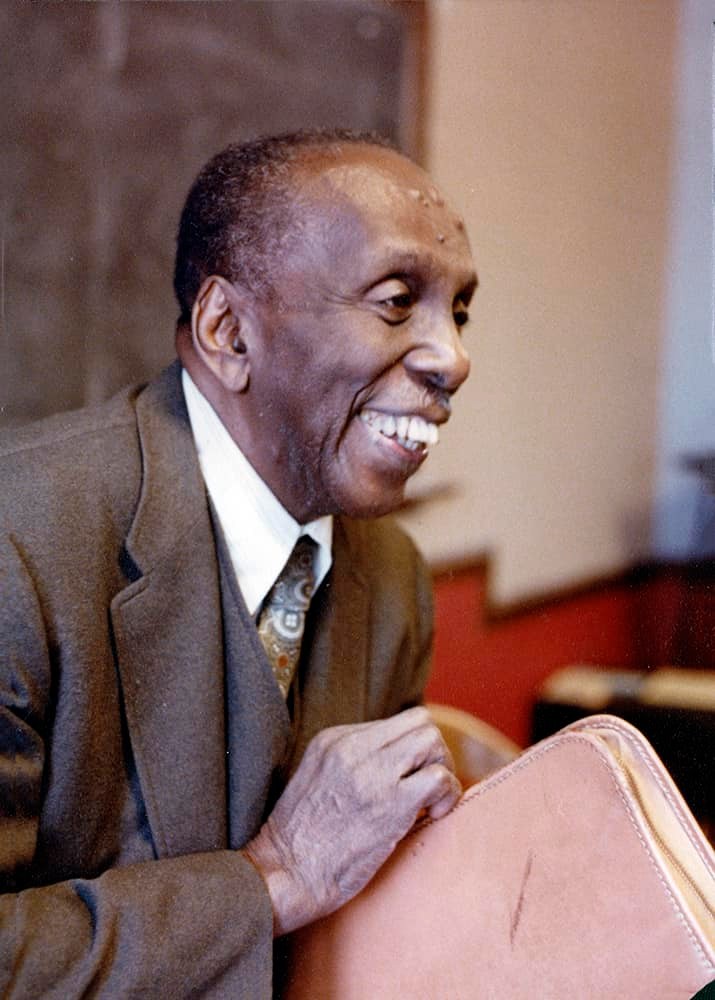
Howard Thurman

“How good it is to center down! To sit quietly and see one’s self pass by! The streets of our minds seethe with endless traffic; our spirits resound with clashing, with noisy silences, while something deep within hungers and thirsts for the still moment and the resting lull.” – Howard Thurman

Taizé Chant

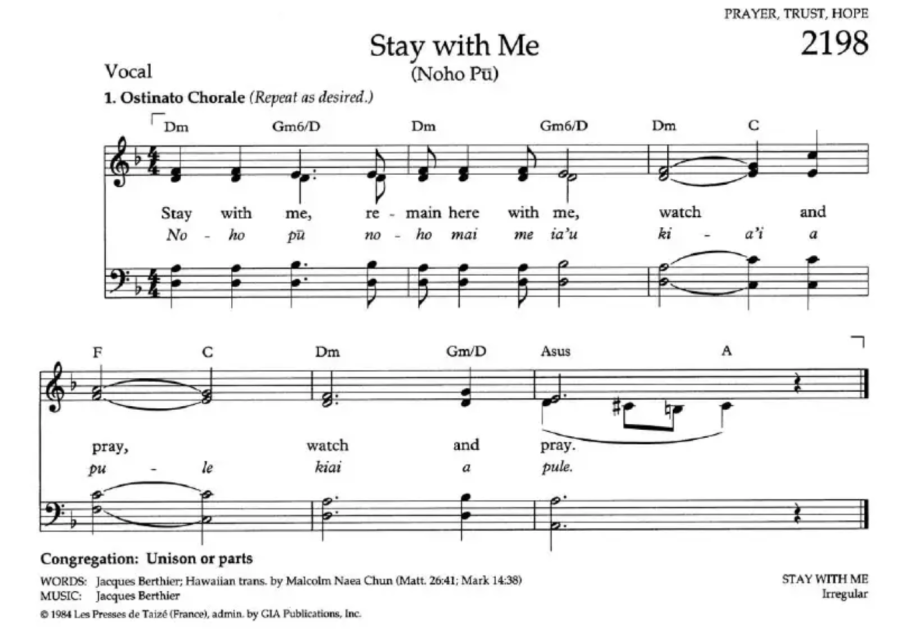
Taizé pronounced (teh-ZAY) is used to describe both an ecumenical community in France and its style of sung prayer and chants. Amidst the multicultural assemblies of global pilgrims at the Community of Taizé in France, a new kind of music developed to fit these global gatherings: brief sung texts, often in Latin, set to simple melodies with verses in several vernacular languages.

A Taizé hour can be a marvelous way to experience a peaceful immersion in the Holy. Taizé chants are sung over and over. The repetition is a means for the words to enter one’s being. The words and the feelings one has when singing them, preferably in the company of others, can become the song that continues in one’s mind, heart, and body even after one has stopped singing.

Soft lighting often welcomes the worshippers as they gather to sing together. Some experience the practice of sung prayer “as waves across water.” Intermixed with the sung prayer are periods of silent reflection to absorb what has been sung, heard, read, and seen.  Icons are sometimes present for visual meditation, bringing to one’s eyes what words bring to one’s hearing.

For me, the feeling generated by singing this way in these settings, also, soothes my vagus nerve, which runs in humans from the brainstem to the digestive system. The effect is a bidirectional communication of stress relief with my parasympathetic (rest and digest) bodily organs. Science says this helps regulate my heart rate, digestion, breathing, and immune response.

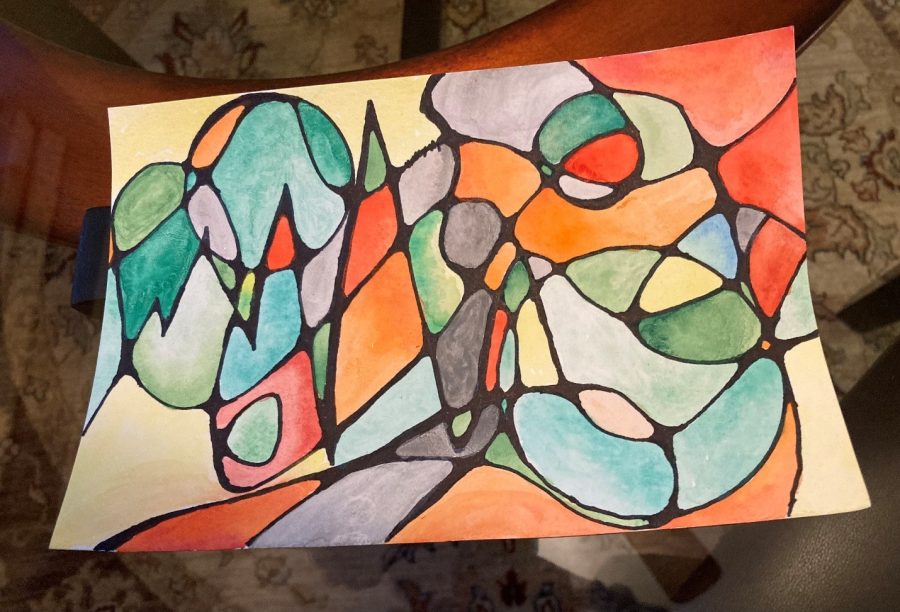
Neurographic Art

“We all want to go somewhere in life, but you can’t open new doors with old keys.” – Pavel Piskarev, D.Sc.

One way to view neurographic art, also known as neurographica, is “the art of world transformation.” Combined with breath deepening and relaxation, it connects body science with art to awaken dormant neurological connections. This process helps us “be able to switch to ecstasy” where everything becomes easy. One method involves moving from a concern in your life to a sense of peace.

Pierre Teilhard de Chardin

“Love is the most universal, the most tremendous and the most mystical of cosmic forces. Love is the primal and universal psychic energy. Love is a sacred reserve of energy; it is like the blood of spiritual evolution.”  The Spirit of the Earth, 1931, VI, 32, 33, 34

Pierre Teilhard de Chardin, S.J. was a French Catholic priest and paleontologist whose commitment to both science and faith led to a spirituality and mysticism focused on the future of this earth as a divine milieu in which we discover God. He worked as a geologist in France and in China and was one of the discoverers of “Peking Man.”

The world-zest,
The essence of all energy,
The cosmic curve,
The heart of God,
The issue of cosmogenesis,
The tide of cosmic convergence,
the God of evolution,
The Universal Jesus,
Focus of ultimate and Universal energy,
Center of the cosmic sphere of cosmogenesis,
Heart of Jesus,
Heart of evolution,
Unite me to yourself

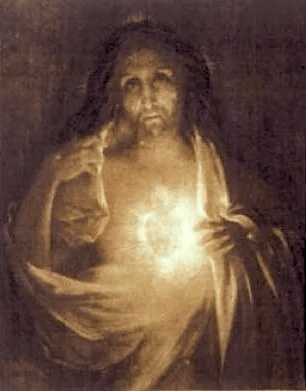
Teilhard wrote this personal prayer on the back of a holy card of the Sacred Heart, which he carried with him for use everywhere he went. The image of Jesus on that card (pictured above) is not the traditional picture of a blood-red physical heart, but rather a softly glowing heart radiating white light in and from the Cosmic Christ.

He writes, in A Note on Progress, “…everything is the sum of the past” and “…nothing is comprehensible except through its history. ‘Nature’ is the equivalent of ‘becoming’, self-creation: this is the view to which experience irresistibly leads us. … There is nothing, not even the human soul, the highest spiritual manifestation we know of, that does not come within this universal law.”

Fireworks of Forgiveness

A mystical experience in the form of a vision shared by Lola Georg.
This vision was revealed during silent meditation in a group setting.

In my mind’s eye, I am walking on a path in a meadow. It is dusk and the sun is setting, creating a sky full of oranges and pinks. I feel peaceful and content. I come upon a small clearing and there, sitting on a log beside a campfire, is Jesus. “I’ve been waiting for you,” he says. “I’m sorry I’m late,” I snap back. “You’re not late,” he continues, “take all the time you need.” I notice that next to the fire, there is a large pile of luggage; suitcases of every shape and size. I realize that these suitcases represent my baggage.

The sun has set and the stars are emerging. Jesus nods towards the luggage. “Are you ready to burn them?,” he asks. “Sure,” I say. I pick up a small briefcase-sized bag, realizing that this bag represents the grievances I hold towards the convenient store clerk that was so rude to me. The bag transforms into a log, and I drop it on the fire. Instantly, the log burns up and turns into a white lily, which shoots off like a rocket into the sky and explodes into a firework of brilliant color. “Cool,” I think. I pick up the next bag; an overnight bag. This bag holds the lies I told in 5th grade that got some of my classmates into big trouble. It turns into a log, which I toss on the fire. Another white lily skyrockets into dark, exploding into a dripping display of green, like a weeping willow tree. “This is fun!”, I think.


I continue on with each of the bags, picking them up, one by one, and tossing them onto the fire. Each bag turns into a log as it hits the fire and then transforms into a white lily before shooting into the dark sky and exploding as a firework. As I work my way through the pile, the bags become heavier and heavier. This one represents my co-worker; this one, my neighbor; my father; my mother; my uncle; my high-school English teacher. Although the bags are becoming heavier, I am feeling lighter.


Finally, there are two bags left, the biggest bags of all. They are oversized suitcases designed for an extended trip, and they look as though they are loaded with stones. One represents my sister; the other, my ex-husband. For how much fun I was having before, I notice that I am reluctant to throw these two suitcases on the fire. It occurs to me that part of my identity is contained within these two bags, and that to put them on the fire means that I will have to loose a part of myself. I realize that I have a sense of victimization in relation to these two people and that to throw the bags on the fire means leaving this part of myself behind. “Okay,” I think to myself, “I can do this.” I start with the sister bag. It is indeed heavy and very difficult to move. I look to Jesus. “Will you help me with this?”, I ask him. He shakes his head no and says, “You made it. You can remove it.”


So I drag and pull the bag towards the fire. I triumphantly pick it up over my head, and as it turns into a log, I smash it down on the fire. Instantly, half a dozen white lilies shoot into the sky and explode into multiple fireworks like a precursor to the grand finale. “One more!”, I think, excitedly. With superhuman strength, I pick up the final piece of luggage, the ex-husband bag. I easy walk over to the fire, again lifting the bag over my head, I emphatically drop it onto the fire. The grand finale of lilies and fireworks has begun! What a sight to behold!


I wipe my hands clean on my thighs. Jesus looks at me and smiles. My baggage, my guilt, my grievances, my angers, my fears – had been transformed into the white lily rockets of forgiveness, which exploded and then dissipated into the black nothingness from whence they came.

Lola’s Reflection:
The first thing I noticed about this vision, was all of the colors -> the setting sun with dimming light in oranges and pinks, the darkness with emergent stars, the fire itself being bright oranges and reds, the white lilies, and the multi-colored fireworks. Fire is often amplified against the backdrop of darkness. Fire can also represent heat and spiritual purification, a burning away of that which is impure, like smelting metal to burn away impurities. Often, fire is used in rituals, and this vision is a personal ritual to rid myself of grievances I carried that where hindering my journey.

I also noticed the metaphor of resurrection in that the luggage turns to logs, which burn in the fire and resurrect as lilies only to become brilliant fireworks against the dark sky, dissipating into nothingness. The fireworks, like the fire itself, are made of many colors. Colors have traditionally had metaphoric meaning. White is the color of innocence and forgiveness; green the color of envy; red, anger. What do different colors mean? The luggage in this vision transforms into logs, which under the heat of fire, transform into lilies, and then fireworks. In what ways has the heat of fire transformed me?

And of course, the lilies. Lilies are the traditional flower of Easter and resurrection. Plus, this whole experience has Jesus as my witness, the man who resurrected into eternal life. Finally, there is the theme of forgiveness. What joy this experience offered me as forgiveness lightens my load! I no longer need to carry this baggage with me, and that is a gift for which I am eternally grateful.