“The spiritual life (adhyatma-jivana), the religious life (dharma-jivana) and the ordinary human life of which morality is a part are three quite different things and one must know which one desires and not confuse the three together.
“The ordinary life is that of the average human consciousness separated from its own true self and from the Divine and led by the common habits of the mind, life and body which are the laws of the Ignorance.
“The religious life is a movement of the same ignorant human consciousness, turning or trying to turn away from the earth towards the Divine, but as yet without knowledge and led by the dogmatic tenets and rules of some sect or creed which claims to have found the way out of the bonds of the earth-consciousness into some beatific Beyond. The religious life may be the first approach to the spiritual, but very often it is only a turning about in a round of rites, ceremonies and practices or set ideas and forms without any issue.
“The spiritual life, on the contrary, proceeds directly by a change of consciousness, a change from the ordinary consciousness, ignorant and separated from its true self and from God, to a greater consciousness in which one finds one’s true being and comes first into direct and living contact and then into union with the Divine. For the spiritual seeker this change of consciousness is the one thing he seeks and nothing else matters.”
– Śrī Aurobindo, from Letters on Yoga, Vol 1
Śrī Aurobindo Ghose, is regarded by some, as India’s greatest modern sage. His Integral Yoga is a synthesis of yogas for our times which offers guidance on ascending to the Divine and bringing divinity to earth. He calls this “drawing down the supermental,” something bigger than one’s own mind, a more loving and peace-filled world.
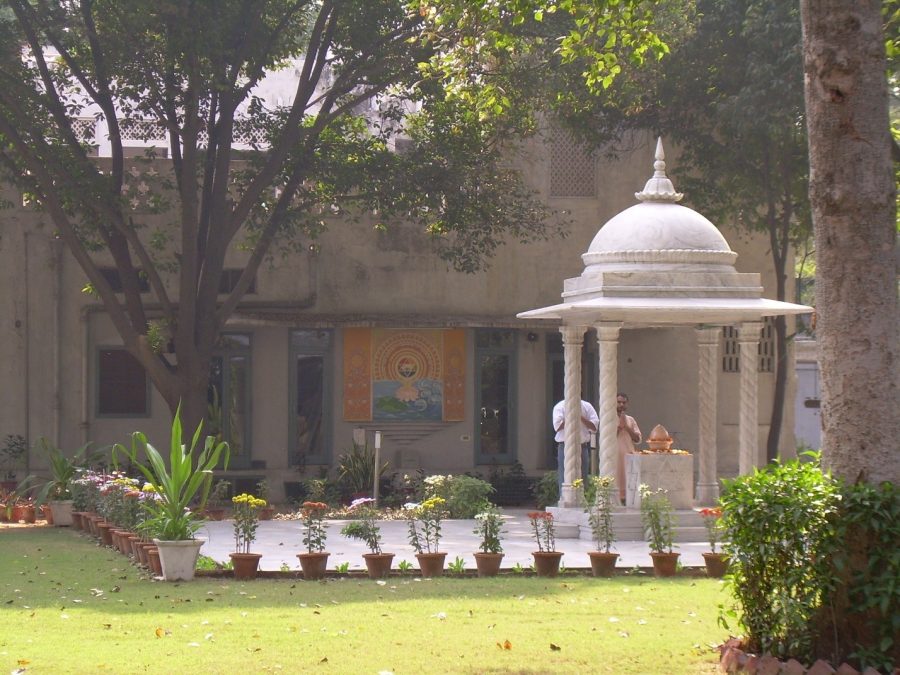
Kitchri, the name of an Indian rice and dal (legume) dish, is the Hindi word for mixture. I see Aurobindo’s teaching as a sort of kitchri of the daily and the eternal. Reading some of his work, a course at Pendle Hill Quaker Center, and several visits to the Aurobindo Ashram in Delhi offered me a bit more insight into his teachings, which, consistent with the opening quote, as I understand it, describes a new birth rather than a transformation of the old world order.
Born in Calcutta India in 1872 and educated in England from the age of 7-21, upon his return to India, Aurobindo worked in civil service, later teaching at Baroda College, and becoming involved in the Indian Nationalist Movement. During 1908-09, he is imprisoned for an Alipore Bomb Case, from which he is later acquitted. In jail, often in solitary confinement, he hears a voice, “Trust in me” to which he responds by letting go of politics and devoting himself to the practices of yoga. In 1909, he offers a speech on the truth of Hindu religion. In 1910, facing another arrest warrant, he hears and follows instruction to go to Pondicherry. From 1914-1921, he publishes Arya, a journal on Indian culture, including translations of the Upanishads and other scriptures. November 24, 1926 is marked as the day of Siddhi, the day Aurobindo experiences bringing down the supramental/ the descent of Truth-Consciousness/ Overmind, after which he goes into seclusion at the Pondicherry ashram, spending 12 hours a day writing to disciples and 8 hours a day walking. On December 5, 1950, in a free and united India, he “withdraws” from his body. I have heard it said, “Śrī Aurobindo’s aura was so full of peace that even during a raging cyclone neither wind nor rain entered into his Room.”
The principal writings of Śrī Aurobindo include, in prose, The Life Divine, considered his single great work of metaphysics, The Synthesis of Yoga, Secrets of the Vedas, Essays on the Gita, The Human Cycle, The Ideal of Human Unity, Renaissance in India and other essays, Supramental Manifestation upon Earth, The Future Poetry, Thoughts and Aphorisms and several volumes of letters including Letters on Yoga. In poetry, his principal work is Savitri: a Legend and a Symbol in blank verse.
 mystical friend